Pesquisar

質問
· 10 hr 前

Struggling with rounded shoulders or upper-back stiffness?

Resistance band pull-aparts are a simple yet powerful exercise to strengthen your shoulders, improve posture, and activate your upper-back muscles. This move targets the rear delts, rhomboids, and traps, making it perfect for warm-ups or daily posture correction. You can do band pull-aparts anywhere—at home, in the gym, or even at the office. Add them to your routine to support shoulder stability, reduce tension, and build balanced upper-body strength. Stay consistent and feel the difference in your posture and mobility!

ディスカッション (0)1
続けるにはログインするか新規登録を行ってください
質問
· 12 hr 前

How AI Is Redefining the Future of Health Insurance

The global health insurance industry is undergoing a profound transformation as artificial intelligence (AI) moves from experimental use cases to core operational infrastructure. Rising healthcare costs, increasing data complexity, demand for real-time decision-making, and the shift toward value-based care are prompting insurers to adopt intelligent systems that enhance efficiency, accuracy, and accessibility. As AI integrates deeper into health insurance ecosystems, it is reshaping product design, pricing, claims processing, fraud detection, patient engagement, and long-term risk management.

This evolution raises an important question: What is driving the rapid acceleration of AI adoption in health insurance, and how is it changing the industry’s operational and strategic landscape?

Why AI Has Become Essential in Modern Health Insurance

Health insurance decisions depend heavily on large, diverse datasets, medical records, hospital billing codes, lifestyle information, pharmacy claims, demographic profiles, wearable device readings, and more. Historically, analyzing this data manually has been time-consuming and prone to errors. AI overcomes these limitations by enabling:

  1. Real-time data processing

Machine-learning models can analyze thousands of data points within seconds, enabling faster quoting, risk scoring, and claims adjudication. This speed is now essential as insurers face rising customer expectations, regulatory pressures, and increasing claim volumes.

  1. More precise risk assessment

AI identifies risk patterns that traditional actuarial models might overlook. By examining both structured and unstructured data, such as physician notes, lab results, or medical imaging, AI enhances underwriting accuracy and reduces uncertainty in premium pricing.

  1. Predictive and preventive intelligence

Predictive analytics helps insurers anticipate hospitalizations, chronic disease progression, and high-risk health events. This capability allows insurers to encourage preventive care, design wellness programs, and partner with healthcare providers to lower long-term costs.

These advantages are positioning AI as a cornerstone of the next era of health insurance.

Transforming Underwriting: From Static Assessment to Dynamic Risk Intelligence

Traditional underwriting relies on historical data and static questionnaires. AI transforms this process into a dynamic, data-rich assessment system.

  • Automated and accelerated underwriting

AI automates document verification, medical history analysis, and risk scoring, reducing turnaround times from weeks to minutes. Natural language processing (NLP) extracts insights from unstructured medical texts, while machine-learning models generate more nuanced risk profiles.

  • Continuous underwriting

With the rise of wearable devices and remote health monitoring, AI allows continuous evaluation of policyholders’ health metrics. This helps insurers offer personalized premiums, reward preventive behavior, and design health plans that adapt to evolving risk patterns.

  • Reduced underwriting bias

AI systems, when properly trained and regulated, help minimize human subjectivity and improve fairness in premium determination by basing decisions on empirical patterns rather than assumptions.

AI-Driven Claims Management: Speed, Accuracy, and Fraud Prevention

Claims processing is often the most complex and resource-intensive aspect of health insurance. AI reshapes this function in several impactful ways.

  • Faster claims adjudication

AI systems quickly validate coverage, cross-check medical codes, examine treatment histories, and detect inconsistencies. This reduces delays and enhances customer satisfaction while lowering administrative costs for insurers.

  • Automated claims triage

Intelligent triage models classify claims by complexity, allowing straightforward cases to be processed automatically while routing complex ones to human adjusters. This hybrid approach ensures both efficiency and accuracy.

Enhanced fraud detection

Health insurance fraud, ranging from inflated bills to phantom treatments, accounts for billions in annual losses. AI strengthens fraud detection through:

  • anomaly detection models that spot irregular billing patterns
  • network analysis that uncovers suspicious provider-patient relationships
  • predictive scoring that flags high-risk claims for further review

These capabilities create a more secure and transparent claims environment.

Personalized Health Plans and Member Engagement

As policyholders expect more personalized products, AI enables insurers to move away from standardized plans toward tailored health solutions.

  • Customized benefits and pricing

Machine-learning algorithms classify policyholders into highly specific segments based on health behavior, risk profiles, and lifestyle patterns. This segmentation guides the creation of flexible plans aligned with individual needs.

  • AI-powered health coaching

Virtual health assistants, chatbots, and mobile apps powered by AI offer reminders, lifestyle tips, medication alerts, and chronic-disease management support. This engagement helps reduce hospital visits and improve long-term health outcomes.

  • Behavior-based incentives

AI-enabled wellness programs use data from activity trackers, diet logs, and medical monitoring devices to reward healthy behaviors with discounts or added benefits. This supports preventive healthcare and cost reduction for insurers.

Enhancing Provider Networks and Care Management

AI supports insurers in managing provider networks, negotiating reimbursements, and optimizing care coordination.

  • Network optimization

AI models analyze provider performance, treatment costs, patient outcomes, and geographic distribution to identify optimal network structures. This ensures better access to quality care for policyholders.

  • Utilization management

Predictive tools estimate the likelihood of emergency visits, readmissions, or complications. These forecasts help insurers design early intervention strategies and collaborate with healthcare providers to reduce unnecessary costs.

  • Value-based care alignment

AI enables insurers to evaluate provider performance against value-based metrics, such as treatment effectiveness and long-term health outcomes, supporting more sustainable reimbursement models.

Ethical, Regulatory, and Operational Challenges

While AI offers immense potential, it also introduces critical challenges.

  • Data privacy and security

Health data is among the most sensitive categories of personal information. Ensuring robust cybersecurity, confidentiality, and compliance with data-protection regulations remains a major priority.

  • Algorithmic transparency

Black-box models can create trust issues when policyholders cannot understand how decisions are made. Insurers must adopt explainable AI (XAI) to ensure fairness and transparency.

  • Integration complexity

AI adoption requires modern IT infrastructure, skilled personnel, and interoperability between legacy systems and new technologies, an obstacle for many insurers.

Addressing these challenges is essential for sustainable AI implementation.

The Road Ahead: Toward Intelligent, Preventive, and Equitable Health Insurance

AI is pushing the health insurance industry toward a more predictive, personalized, and efficient future. As algorithms learn from growing volumes of health data, insurers are shifting from reactive claim reimbursement to proactive health management. This transition promises improved care outcomes, reduced costs, and greater operational excellence.

However, the industry’s next phase will depend on balancing innovation with ethical responsibility. Transparent algorithms, strong governance frameworks, and equitable data practices will determine how effectively AI transforms health insurance for the long term.

AI is not just enhancing health insurance; it is redefining its purpose: enabling healthier populations, optimized care delivery, and resilient financial systems.

Source: https://researchintelo.com/

ディスカッション (0)1
続けるにはログインするか新規登録を行ってください
記事
· 12 hr 前 5m read

ミラーの現在の状態&情報をコマンドで確認する方法

これは InterSystems FAQ サイトの記事です。

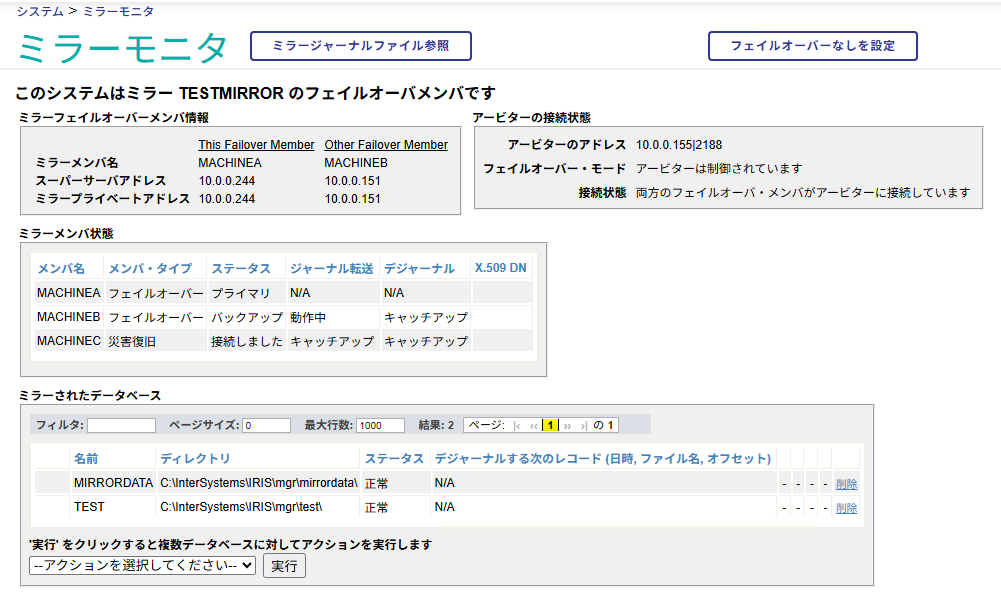
ミラーの現在の状態は、管理ポータルのミラーモニタで確認できます。

こちらのトピックでは、それらの情報をコマンドで確認する方法をご紹介します。


(1) フェイルオーバメンバ(プライマリ・バックアップ)の状態を確認する

(2) 非同期メンバの状態を確認する

(3) ISCAgentの状態を確認する

(4) 定期的にミラーステータスを取得するサンプル(ツール)のご紹介


では、以下のようなミラーの状態を確認してみます(以下はフェイルオーバーメンバ・プライマリの状態)。


(1) フェイルオーバメンバ(プライマリ・バックアップ)の状態を確認する

フェイルオーバメンバのミラーの状態は、SYS.Mirror クラスの GetFailoverMemberStatus メソッドで確認できます。
結果は出力引数に$list形式で返されます。詳細はクラスリファレンスをご覧ください。

   例)
    プライマリ、バックアップともActiveな状態

// フェイルオーバーメンバ(プライマリまたはバックアップ)で確認
// 以下はプライマリで実行した例
%SYS>set x=##class(SYS.Mirror).GetFailoverMemberStatus(.thismember,.othermember)
 
%SYS>zwrite thismember
thismember=$lb("MACHINEA","10.0.0.244|2188","Primary","Active","10.0.0.244|1972","10.0.0.244|1972")
 
%SYS>zwrite othermember
othermember=$lb("MACHINEB","10.0.0.151|2188","Backup","Active","10.0.0.151|1972","10.0.0.151|1972")


1.1) 自ノードがプライマリメンバーの場合、$list() の4番目に返される Status値には以下のような状態が返ります。

 Active
 Restart
 Trouble
 Failover
 Recovery
 Deciding
 Exit
 Inactive 


1.2) 自ノードがメンバーのバックアップメンバーの場合、Statusには以下のような状態が返ります。

 Active
 Catchup
 Restart
 Trouble
 Failover
 Recovery
 Deciding
 Exit
 Inactive 


(2) 非同期メンバの状態を確認する

非同期メンバではAsyncDejournalStatus() の戻り値のStatusで確認します。

// 非同期DRで実行
%SYS>write ##class(SYS.Mirror).AsyncDejournalStatus("TESTMIRROR")
running

フェイルオーバ・バックアップメンバまたは非同期DRメンバでの遅延状態は、以下のクラスメソッドで確認できます。
戻り値が 1の場合は遅延はない状況となります。

%SYS>write ##class(SYS.Mirror).DistanceFromPrimaryJournalFiles()
1
%SYS>write ##class(SYS.Mirror).DistanceFromPrimaryDatabases()
1


また、以下のクラスメソッドは、遅延がある場合、その遅延時間(秒)を戻り値として返します。

%SYS>write ##class(SYS.Mirror).JournalFilesLatency()
0         // 遅延なし
%SYS>write ##class(SYS.Mirror).DatabasesLatency()
0         // 遅延なし


(3) ISCAgentの状態を確認する

ISCAgent が動作しているかどうかは、以下のように確認できます。

%SYS>write ##class(SYS.Agent).IsRunning()
1


(4) 定期的にミラーステータスを取得するサンプル(ツール)のご紹介

このツールでは、システムクラス SYS.Mirror のクエリMemberStatusList を使用しています。
do ##class(%ResultSet).RunQuery("SYS.Mirror","MemberStatusList") と同様の内容です。

%SYSネームスペースに、zmirrorstat.mac の名前で保存・コンパイルします。

Start(int,n,mirror)	;
    do Header()
	;
    for i=1:1:n {
	    Do MirrorStatus(mirror)
	    Hang int
    }
	;
 	Quit
MirrorStatus(mirror) {
	set rs=##class(%ResultSet).%New("SYS.Mirror:MemberStatusList")	
	set n=rs.GetColumnCount()
	do rs.Execute(mirror)
	while rs.Next() {
		write $ZDATE($P($H,",",1)),",",$ZTIME($P($H,",",2)),","
    	for i=1:1:n Write rs.GetData(i) w:i'=n ","
    	write !
	}
}
Header() {
	set hd1="Date,Time"
	write hd1,","
	set rs=##class(%ResultSet).%New("SYS.Mirror:MemberStatusList")	
	set n=rs.GetColumnCount()
    for i=1:1:n Write rs.GetColumnHeader(i) w:i'=n ","
	write !
}

例:ミラー名:MIRRORTEST のステータスを、1秒おきに3回実行します

%SYS>do ^zmirrorstat(1,3,"TESTMIRROR")
Date,Time,Member Name,Current Role,Current Status,Journal Transfer Latency,Dejournal Latency,Journal Transfer Time Latency,Dejournal Time Latency,Display Type,Display Status
08/01/2025,11:17:26,MACHINEA,プライマリ,動作中,N/A,N/A,N/A,N/A,フェイルオーバー,プライマリ
08/01/2025,11:17:26,MACHINEB,バックアップ,動作中,動作中,キャッチアップ,動作中,キャッチアップ,フェイルオーバー,バックアップ
08/01/2025,11:17:26,MACHINEC,非同期,非同期,キャッチアップ,キャッチアップ,キャッチアップ,キャッチアップ,災害復旧,接続しました
08/01/2025,11:17:28,MACHINEA,プライマリ,動作中,N/A,N/A,N/A,N/A,フェイルオーバー,プライマリ
08/01/2025,11:17:28,MACHINEB,バックアップ,動作中,動作中,キャッチアップ,動作中,キャッチアップ,フェイルオーバー,バックアップ
08/01/2025,11:17:28,MACHINEC,非同期,非同期,キャッチアップ,キャッチアップ,キャッチアップ,キャッチアップ,災害復旧,接続しました
08/01/2025,11:17:29,MACHINEA,プライマリ,動作中,N/A,N/A,N/A,N/A,フェイルオーバー,プライマリ
08/01/2025,11:17:29,MACHINEB,バックアップ,動作中,動作中,キャッチアップ,動作中,キャッチアップ,フェイルオーバー,バックアップ
08/01/2025,11:17:29,MACHINEC,非同期,非同期,キャッチアップ,キャッチアップ,キャッチアップ,キャッチアップ,災害復旧,接続しました
 
%SYS>
ディスカッション (0)0
続けるにはログインするか新規登録を行ってください
質問
· 2026年1月8日

What First-Time Car Owners in Claymont Should Know About Long-Term Vehicle Care

Owning your first vehicle is exciting, but it also comes with responsibilities that many drivers underestimate. Beyond fuel and insurance, long-term reliability depends on understanding how small maintenance decisions affect performance, safety, and resale value. For Claymont drivers, local conditions and driving patterns make informed care even more important.

New car owners often assume that maintenance only matters once warning lights appear. In reality, consistent attention and Quality Car Services help prevent early wear, reduce unexpected expenses, and keep vehicles running efficiently well past their warranty period. Preventive maintenance builds a foundation for reliability rather than reacting to problems after damage has occurred.

One of the biggest challenges for new drivers is knowing where to go for honest advice. Choosing the Best mechanic shop means working with professionals who explain issues clearly, prioritize safety, and recommend only necessary repairs. Trustworthy guidance helps first-time owners avoid overpaying while learning how their vehicle truly operates.

Local expertise becomes especially valuable when dealing with everyday wear and tear. Shops specializing in Auto repair Claymont DE understand how traffic patterns, road conditions, and seasonal changes impact vehicles differently than other regions. This insight allows car mechanics to tailor inspections and repairs more accurately.

Many beginners overlook the exhaust system because issues aren’t always obvious. However, professional Exhaust system repair services support fuel efficiency, emissions control, and engine performance. Early inspections can catch corrosion or airflow problems before they affect drivability or inspection results.

Braking confidence is critical for new drivers, especially in busy or unfamiliar traffic situations. Searching for Brakes service near me should be part of routine ownership, not just an emergency response. Regular brake checks help maintain stopping power and reduce the risk of sudden system failure.

Noise changes are another common concern for first-time owners. Rattling or humming often points to issues requiring Muffler repair, which improves ride comfort and protects surrounding exhaust components from damage caused by vibration or leaks.

Beyond these essentials, long-term vehicle health depends on a balanced approach to maintenance. Services such as oil change near me scheduling, tire repair shop visits, collision repair readiness, and auto body repair shop support all contribute to overall automotive care. Many leading competitors rank highly by offering complete automotive services through a trusted auto repair shop that emphasizes communication and reliability.

Search trends like mechanic near me and car repair shop continue to grow because drivers value accessibility, transparency, and consistent results. For first-time owners, building a relationship with skilled automotive experts early creates confidence and prevents costly mistakes down the road.

Share your reviews here: https://maps.app.goo.gl/yhkeWS7NVtXvFKD88 

Contact Us Today!

Website: https://claymontauto.com/

Location: 3506 Philadelphia Pike Claymont DE 19703

Contact: 302-792-1700          

Email: contact@claymont.com

ディスカッション (0)1
続けるにはログインするか新規登録を行ってください
お知らせ
· 2026年1月8日

*New Course* Developing Custom Components for Integrations – In Person February 10-12, 2026 / Registration space available

Developing Custom Components for Integrations – In Person (Boston, MA) February 10-12, 2026

  • This 3-day course teaches implementation partners, integrators, developers, and analysts how to create custom interfaces using InterSystems integration technologies.
  • Students build a Production using InterSystems® Objects, graphical tools in the Management Portal, Business Process Language (BPL), the adapter library, and an IDE.
  • Students create business services, business processes, business operations, and messages.
  • This course is applicable for users of InterSystems IRIS® data platform, InterSystems IRIS® for Health, and HealthShare® Health Connect.
  • Prior experience with InterSystems Objects programming is required. Refer to the course description page for more information.

SELF REGISTER HERE

ディスカッション (0)1
続けるにはログインするか新規登録を行ってください